
You are more than your worst chapter
We’ve been told that healing is a life sentence. It’s not.

We’ve all heard the advice about healing. We’re told it’s a journey, a process, a sacred unfolding. We’re given permission to take our time, to feel our feelings, and to sit in the wreckage of an unhealthy season until we’ve fully made sense of the debris.
But there is a dark side to the healing industrial complex.
Sometimes, “I’m still healing” becomes a polite way of saying “I’m still stuck.” It becomes a comfortable room we sit in so we don’t have to go back outside and face the wind.
If you aren’t careful, the work of processing a difficult chapter can eventually become more consuming than the struggle itself. You can spend years turning the same memories over like smooth stones, looking for a hidden meaning or a final piece of closure that will finally make the pain make sense.
The hard truth is that closure isn’t something a partner gives you, and it isn’t something that happens to you once you’ve analyzed a situation enough. It’s a decision you make when you realize that the “why” doesn’t matter as much as the “what now.”
The survival mode hangover
when you’ve spent years walking on eggshells, your nervous system gets addicted to the stress. You become an expert at managing moods, predicting storms, and shrinking yourself to fit into the small spaces left for you.
Even when the storm passes—even if the relationship stabilizes or the conflict subsides—the silence can feel deafening. You might mistake that peace for emptiness. You might even find yourself subconsciously picking at old scabs just to get that hit of adrenaline back.
You’ve been in survival mode for so long that you’ve forgotten how to just live. You’ve forgotten how to be spontaneous, how to be creative, or how to have a thought that isn’t a reaction to your history.
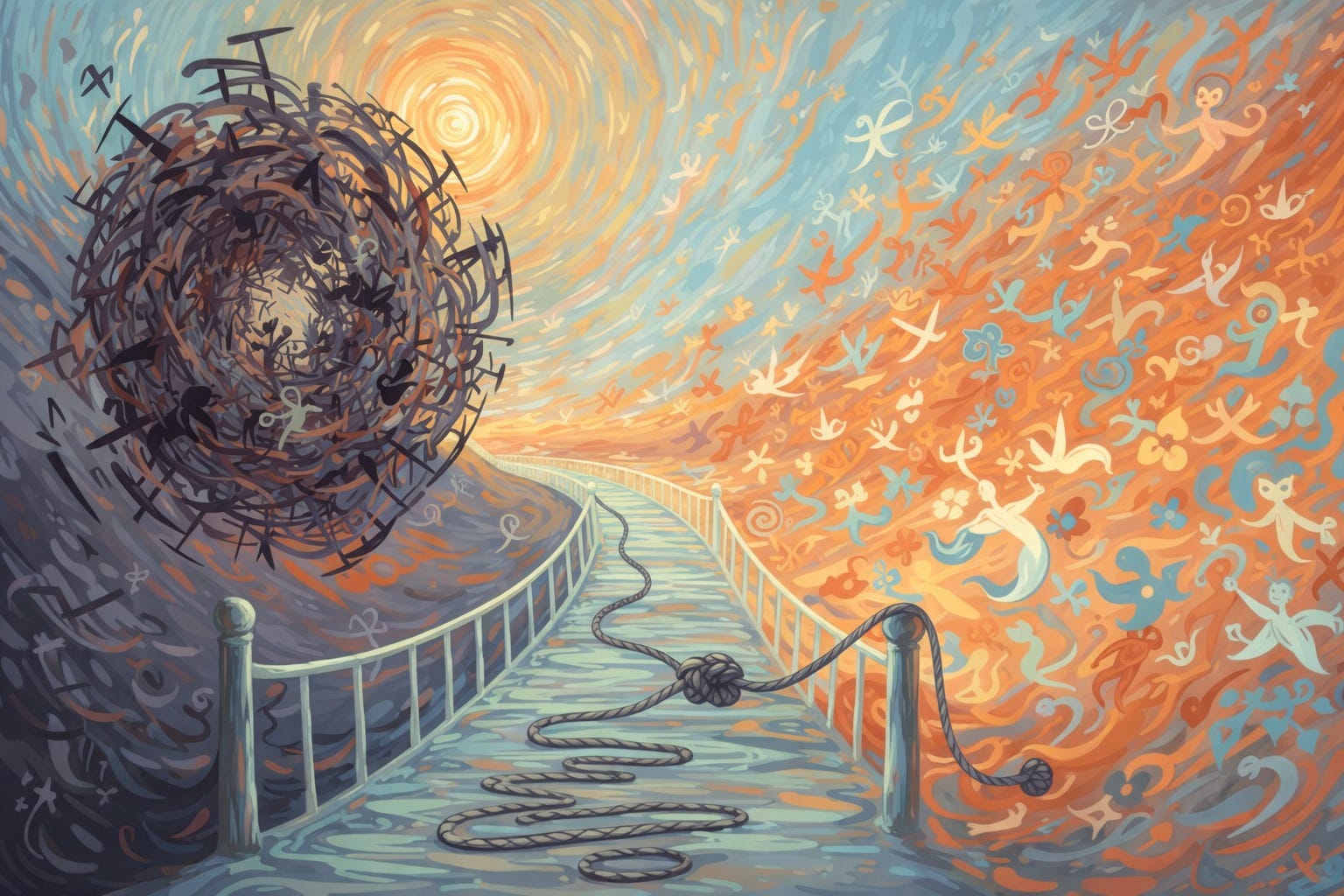
Healing is a bridge, not a home
Processing is necessary. You have to grieve the versions of your life that didn’t pan out. You have to look in the mirror and figure out why you tolerated the intolerable for so long. You have to take responsibility for your own behavior and the parts of you that ignored the red flags.
But you cannot live there.
There is a point where processing stops being a place you visit and becomes a place you reside. It’s possible to stay in the energy of the past for far too long, turning the same memories over and over, trying to find a sense of justice or understanding that may never arrive.
At some point, the analysis stops being productive and starts being a prison. It becomes a way to stay connected to your pain under the guise of “doing the work.”
Reclaiming the play
The ultimate goal of recovery isn’t to become a person who understands their trauma perfectly. It’s to become a person who can enjoy a meal, laugh at a joke, and exist in the present without checking it against the ghost of a bad year.
The danger of an unhealthy dynamic isn’t just the damage it does in the moment; it’s the way it robs you of your ability to play. It kills your spontaneity. It makes you a manager of your own emotions and a sentry for your own heart.
Real healing isn’t about reaching a place where the past doesn’t hurt. It’s about reaching a place where the past is no longer the most interesting thing about you.
Drop the rope
If life still feels like a construction site long after the demolition is over, it might be time to put down the tools.
You don’t need more insight. You don’t need another therapy breakthrough. You don’t need a final apology from anyone else to validate your experience.
You need to decide that the danger has passed. If you are still holding onto the heavy end of a rope, waiting for the other side to pull back or let go, you are the one keeping the tension alive.
Drop the rope. Stop being a student of your own misery and start being the architect of your own joy. Healing was never meant to be a life sentence. It was supposed to be the thing that got you back into the world.
The world is still there. Go live in it.
The dangerous myth of the “easygoing” partner

I used to wear my “low maintenance” label like a badge of honor.