
Your relationship isn't dying from conflict.
It's not the fights. It's not the distance. It's the sameness.

Friday, 9pm. You’re home, your partner’s home, neither of you is going anywhere. One of you says, “We should do something this weekend.”
“Yeah. Totally.”
You pull out your phone to find something fun. Thirty seconds later you’re on Instagram. By Sunday night you’ve done nothing, again, and neither of you is mad about it. You love each other. Home was fine. That’s the problem.
I’ve been on both sides of this scene more times than I can count.
“Fine” is the word we use when nothing is wrong and nothing is happening.
We’re taught to worry about the dramatic relationship killers. Affairs. Fights that go too far. Financial stress. Those are real, and they do real damage. But they aren’t what takes most long-term couples down. What takes most of us down is much quieter: another Tuesday that feels exactly like the last Tuesday. Another weekend you’ll forget by Wednesday. It’s slow, invisible, easy to miss until you’re already deep in it and wondering when things changed.
Boredom is the leading indicator
I thought the things that killed relationships were dramatic. Conflict. Bad communication. Money fights. All of that stuff.
None of it got us. We got bored.
Not “bored” in a crisis-y, flashing-red-lights way. The slow kind. The Tuesday that feels like every other Tuesday. The weekend you can’t remember by Wednesday. The conversation you’ve had so many times you just skip to the end without bothering to say the middle out loud.
Bored couples don’t fight more. They feel less close. One of you notices first (usually whoever has a lower tolerance for “fine”). The other catches up months later. Nobody slams a door. You just drift.
Boredom is how the drift actually moves. It isn’t that something snaps one day. It’s that nothing happens for long enough that you stop being a couple and start being two people living parallel lives in the same house.
Why your nice dinner isn’t doing what you think
Here’s something I missed for years.
There’s a difference between pleasant activities and novel ones, and the difference matters more than you’d expect.
Pleasant activities maintain. The familiar restaurant, the movie you both already wanted to see, the comfortable Saturday-night couch ritual. They feel good. They’re nice. And they don’t really grow anything.
Novel activities grow things. Something unfamiliar. A bit challenging. New to both of you. (The “both” matters. If one of you has already been there, it’s not novel for the relationship, even if the other hasn’t.)
The dose doesn’t even need to be heroic. A short evening of something neither of you has tried does more for how connected you feel than a month of familiar dinners. We’re talking less time than you spend deciding what to watch on Netflix.
Expansion is what does the work. Not adrenaline. Not date-night theater. Just the two of you, in something unfamiliar, together.
Think about the early months of your relationship. Everything was novel. You were learning what your partner does on a road trip. What they order. What surprises them. What irritates them in traffic. You were building a map of a whole human while simultaneously handing them the map to you. That’s what “the spark” actually is. It isn’t magic. It’s two people expanding at the same time.
Then you learn each other, which is lovely, and also the end of that particular kind of expansion. Conversations loop. Restaurants become “our spots.” Stories get recycled. You stop expanding. Not because anything is wrong, but because you’ve finished the first round of learning each other.
Losing the spark isn’t a mystery. It’s running out of newness.
The part nobody tells you is that you can generate it again. On purpose. Whenever you want.
What this has to do with desire
Novelty does something bigger than just making you feel closer. It moves desire.
And not just in the moment. The effect sticks around. It isn’t about the activity being sexy, or about you spending more time together, or even about feeling closer during it. There’s something about newness itself that shifts the chemistry.
This matters especially if your desire has quietly drifted into what I’d call “show up when the conditions are right” mode. If intimacy doesn’t just bubble up out of nowhere anymore. If it waits for something to give it permission to show up. (Which, for the record, is a completely normal way desire works for a lot of people, especially after the honeymoon chemistry settles down.) You don’t sit around “feeling like” being intimate. You create the conditions where desire has room to surface. A new restaurant does that. The same couch does not.
A few weeks ago I wrote about how desire doesn’t die in long relationships. It hides under grocery lists and sleep debt and “did you move the laundry over?” This is the actual mechanism. Sameness buries it. Newness digs it back up.
There’s a darker version of this worth knowing. When your relationship is actively expanding, when the two of you keep surprising each other, your attention to other people quietly dims. When expansion stops, that attention comes back, and everyone outside starts looking a little more interesting. This isn’t a character flaw. It’s what happens when the inside of the relationship stops producing anything new.
Expansion doesn’t just make your relationship better. It makes the rest of the world a little less magnetic.
The loop that keeps you stuck
The cruelest part is that boredom is self-reinforcing.
The more bored you feel, the less likely you are to initiate the thing that would break it. You fall back to the familiar because the familiar is easier. Every time you fall back, it gets a little heavier. Repeat.
I lived inside this loop for years. Same five restaurants, same Sunday routine, same conversations on rotation. It never felt like a crisis. It felt like being married. It felt like what everyone does.
By the time I figured out that the sameness was the actual problem, I’d stopped looking for ways out of it. Boredom had already won, and I hadn’t even noticed the fight.
That’s why “we should do something this weekend” dies every Friday night. You aren’t lazy. You’re just in a loop. The loop tells you the couch is easier than whatever new thing you’d have to arrange, and in the short term, the loop is right.
Breaking out of it doesn’t take a grand gesture. It takes one Tuesday-night decision.
What “novel” actually means
There are roughly six categories of activity that keep excitement alive in long-term relationships: adventurous, passionate, playful, romantic, sexual, spontaneous.
If “spontaneous” makes you twitch because you have two kids and a shared Google Calendar (hi, same), that’s fair. Spontaneous for you might just mean taking a different route home and stopping somewhere you’ve never been. The bar adjusts to your actual life.
Notice what isn’t on that list. Expensive. Elaborate. Time-consuming. Instagram-worthy.
Novel means unfamiliar to both of you. That’s the whole bar.
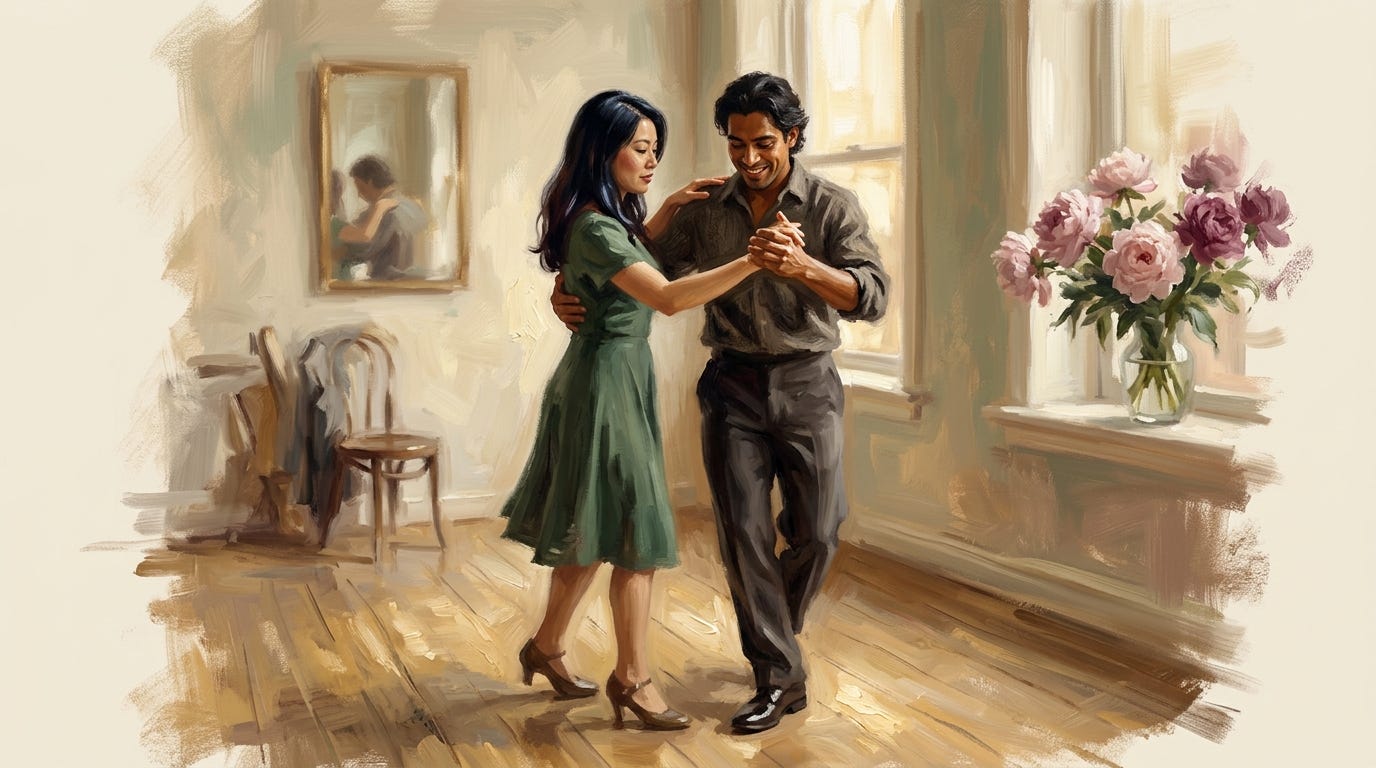
Some examples from my real life: driving to a part of the city neither of us had explored. Cooking a cuisine we’d never tried. Going to an open mic we’d have scrolled past on any normal night. Taking a dance class where we were both objectively terrible (that one was rough, and also the most memorable date of the month). Nothing intense. Just new.
The rough dosage is about ninety minutes a week. One evening. One unfamiliar thing. That’s enough to actually move something.
You don’t need to become “adventurous people.” You just need to be people who, once a week, choose unfamiliar over easy.
Why this shows up everywhere else
Newness isn’t a side project in your relationship. It’s what’s underneath a bunch of other things that matter.
The slow slide from partners to roommates doesn’t happen in one dramatic moment. It happens in identical weekends, one at a time, until you look up and you’re living inside the exact life you swore you wouldn’t. Boredom is the vehicle. Newness is what breaks it.
When your partner does something new on their own (a hobby, a class, a friendship you’re not part of), they come back a little different. You see them a little more freshly. That’s novelty you didn’t have to generate yourselves, and it matters more than people admit. You don’t have to produce all the newness between the two of you. Sometimes they bring it home.
Expansion is what’s underneath everything else that works in a relationship. Without it, sameness wins. With it, everything else has fuel.
What boredom won’t do
Boredom won’t announce itself. It won’t raise its voice. It won’t threaten to leave.
It’ll just sit on your couch, every Friday night, scrolling its phone, while the two of you wonder why things don’t feel the way they used to. It’ll convince you that this is what long-term relationships feel like. It’ll tell you the couch is fine. The routine is fine. Everything is fine.
It’s not fine. “Fine” is the most dangerous word in a long relationship.
You don’t fix boredom by trying harder at the same things. You fix it by doing different things, together, often enough to count, small enough that you’ll actually do it.
Comfort isn’t what you’re short on. Newness is.
This week: pick one thing neither of you has ever done. Something unfamiliar. Doesn’t have to be expensive or elaborate. A restaurant you’ve never tried. A trail you’ve never walked. A neighborhood you’ve never explored. Put it on the calendar for this weekend. Not “we should.” An actual time, an actual place. The bar is lower than you think. The effect is bigger than you’d expect.
Next week I want to write about the hidden operating system running your household. What happens when one person ends up carrying all of it, and nobody notices until something cracks.
If you nodded at any of this, tap the heart. That’s how it finds the next couple on the couch.
If you’ve figured out how to keep the couch from winning, tell me in the comments. I’m collecting Tuesday-night decisions that actually work.
My husband and I were like that couple. We took up square dancing for several years but quit after our daughter was born. It was becoming boring and I was glad we quit. We weren’t very creative in finding something new but after moving to Colorado, several opportunities presented themselves even exploring our beautiful new city was fun. Now my husband is gone and our daughter, her husband, and her family and I all live in the house where she grew up. Oh to turn back the clock to when he was here. The just normal times have become the best of times.
Another great essay!