
Same dinner, different marriage
How turning routines into rituals changed everything

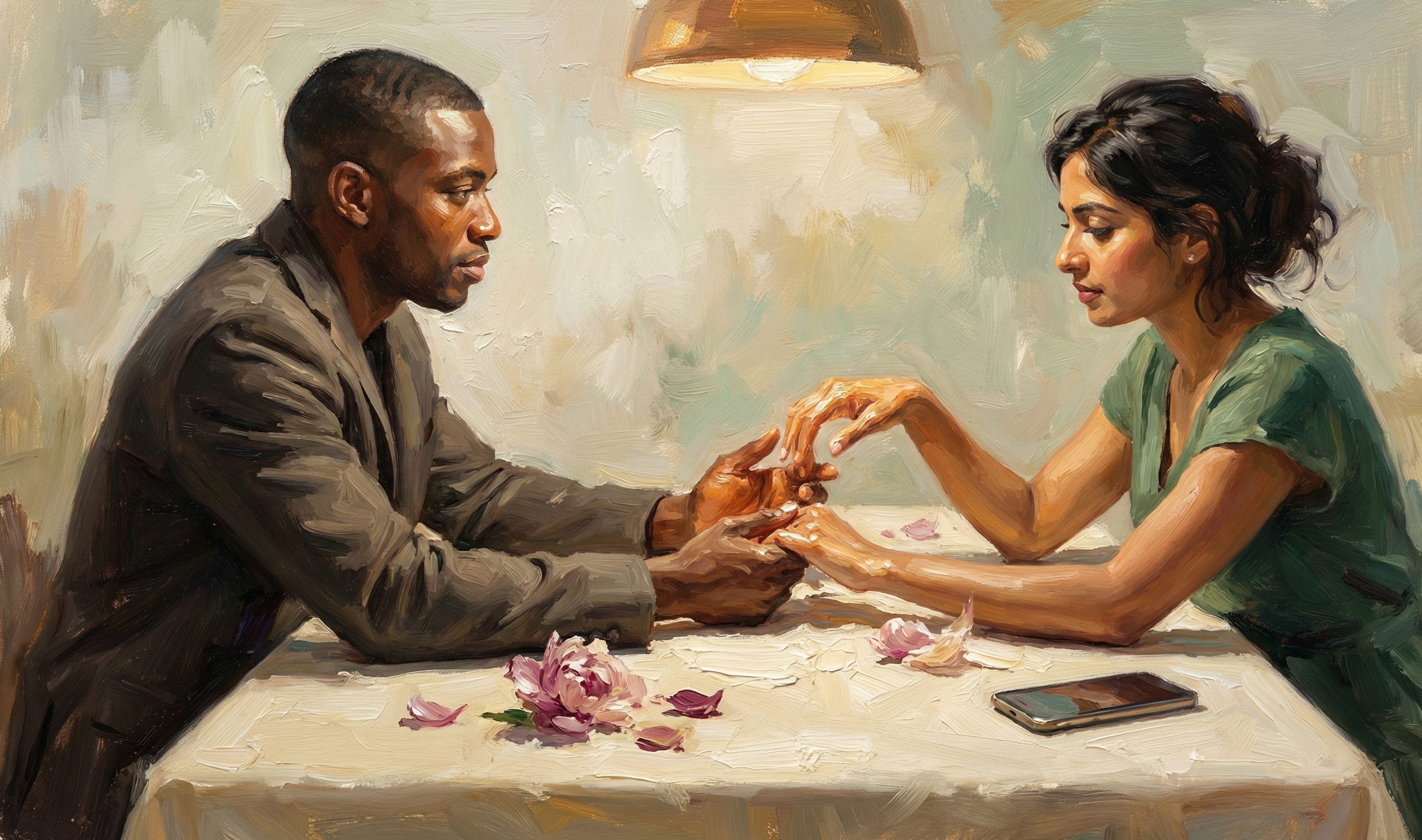
You can tell everything about a couple by watching them eat.
Last week at a restaurant, two tables next to each other. One couple: phones propped against water glasses, scrolling between bites. One of them said something about a plumber. The other nodded without looking up. They paid, left a decent tip, and walked out side by side in perfect silence. Nothing was wrong. Nothing was anything.
The other table: leaning in, one of them gesturing with a fork, the other laughing hard enough that the waiter looked over. No phones in sight. At one point she said something quiet and he put his hand on hers and just held it there for a beat. They weren’t performing. They were just — present. In a way the first couple wasn’t.
Same restaurant. Same Saturday night. Same behavior — two people eating dinner. Completely different experience.
I’ve been both of those couples.
In my first marriage, we were table one. Same time, same place, same silence. We ate. We scrolled. Sometimes one of us would mention the schedule for tomorrow. Then dishes, TV, bed. We did this for years and neither of us ever named what was missing, because nothing was technically wrong. The food was fine. The logistics got handled. We were efficient.
Now, with my partner, most nights we’re table two. Not because we’re better people or more in love. Because we do dinner differently. The food is the same. The time is the same. The architecture is different.
And that word, architecture, is the whole point of what I want to talk about today.
The autopilot problem
Think about how it works. During courtship, the relationship is the main event. It’s front and center. You plan for it, think about it, invest in it. It’s the most interesting thing in your life.
Then you get married. Then maybe kids come. Then careers peak and parents age and the mortgage needs attention and the dishwasher breaks again. And the relationship quietly slides from the foreground to the background. Not because anyone decided it should. Because nobody decided it shouldn’t.
The relationship keeps running, but nobody’s flying it. You maintain the house, coordinate the schedules, split the labor. The machinery of partnership works fine. It’s the connection that’s on autopilot. No active input, no intentional investment, no one asking: is this actually working for us?
Two weeks ago I wrote about The Drift — the slow fade from partners to roommates. Last week was about bids for connection — the micro-moments you’re catching or missing a hundred times a day. This week is about something more structural: the difference between a routine and a ritual. And why that difference might be the most important design decision in your entire relationship.
Same behavior, different architecture
Here’s the distinction that changed how I think about every hour between 6pm and 10pm:
A routine is “we eat dinner at 7.”
A ritual is “we eat dinner at 7, phones in the drawer, and we each share one thing that happened today that the other person wouldn’t know about.”
Same behavior. Same time commitment. Same dinner. But the second version has three things the first one doesn’t: intention, structure, and meaning.
A routine is mechanical. It answers “what needs to happen.” You eat dinner. Done. Checked off. You don’t think about it afterward because there’s nothing to think about.
A ritual answers a different question: “who are we.” It has weight. You remember it afterward. It becomes something you’d actually miss if it stopped.
The shift from one to the other doesn’t require a renovation. It requires three things: a clear beginning (a signal that says “this is starting now”), an intentional middle (we’re present, we’re talking about something real), and a natural ending (we return to the rest of the evening). Start, middle, close. Without those markers, the thing stays formless. Another dinner, another evening, another night where you were technically together and functionally alone.
Here’s the part that matters most: any routine you already have can become a ritual. You don’t need to add anything to your schedule. You don’t need to carve out new time you don’t have. You need to redesign the time you’re already spending.
Six hours a week
Here’s what actually moves the needle. Not therapy. Not a retreat. Not some 10-step program. Six hours a week of intentional connection. That’s it. Distributed across the week in small, unglamorous pieces:
Two minutes every morning, learning one thing about your partner’s day ahead before you leave.
Twenty minutes at reunion: a real greeting when one of you comes home, a six-second kiss (not a peck, an actual deliberate kiss), a real conversation about the day that isn’t about logistics.
Five minutes of specific appreciation, not “thanks for dinner” but “I noticed you handled bedtime solo tonight and I appreciate it.”
Five minutes of just being close. Holding hands, a squeeze in the kitchen, sitting together on the couch.
A two-hour date once a week.
A one-hour check-in: how are we doing? What do we need?
Add it up: about 32 minutes a day on weekdays, plus a date night and a weekly check-in.
That’s not a lot. And it works because these aren’t random nice things. They’re rituals. Predictable, intentional, structured moments that signal to both partners: this relationship is being actively maintained. Someone is flying the plane.
What I love about six hours is that it respects exhaustion. It doesn’t pretend you have unlimited time and energy. It just says: you already have the time. Use it on purpose.
Why three dinners beat seven
Here’s something that surprised me: it’s not how often you do the ritual. It’s how much meaning you put into it.
A couple who eats together three nights a week and treats those meals as sacred (phones gone, real conversation, eye contact) gets more out of them than a couple who eats together every night with the TV on and nothing to say. Frequency doesn’t matter. Intention does.
Think about it. Most dinners take about 20 minutes. Three real ones a week adds up to roughly one hour. That’s less time than a single movie. One hour a week. If someone told you one hour could shift the entire emotional temperature of your house, you’d find the hour.
But here’s the catch: both of you have to see it as something that matters. Not just a schedule item. Not just compliance. If one person treats dinner as a ritual and the other treats it as an obligation, the whole thing falls flat.
Which means you can’t just announce “we’re doing phone-free dinners now” and expect magic. You have to build it together. The ritual has to belong to the relationship, not to one person’s improvement project.
Why the same thing every night kills something important
There’s a tension here that’s worth naming. If rituals are about repetition and structure, doesn’t that mean we’re just building a fancier rut?
No. Because the best rituals evolve.
Humans need to grow. We need new things. And couples who stop experiencing anything new together pay a price that compounds quietly: boredom at year seven becomes unhappiness at year sixteen. It’s not dramatic. It’s just slow.
But the antidote isn’t expensive. Seven minutes of doing something unfamiliar together, something that requires a little coordination and problem-solving, is enough to shift how you feel about each other. Not a weekend getaway. Not skydiving. Something small that you figure out together.
And when couples keep doing new things, something else happens: desire comes back. Novelty feeds desire. Desire feeds satisfaction. That pathway is real, and it doesn’t require a passport or a budget.
So the ritual isn’t supposed to be a fixed script. The dinner ritual might have the same setup every night, but what you talk about should change. The Saturday morning ritual might be coffee together, but where you drink it can vary. The structure stays stable. The content stays alive.
A ritual that never changes becomes a routine. The structure provides safety. The novelty within it provides aliveness. You need both.
Five upgrades you can try tonight
These aren’t new activities. They’re redesigns of things you already do. The time cost is close to zero. The shift is in the structure.
If you’ve read anything about building habits, you know the trick: attach the new thing to something you already do. After [current habit], I will [new behavior]. You don’t need motivation. You need a trigger. Here are five.
1. Dinner. After we sit down, phones go in another room. Not flipped over. Gone. One question each that isn’t about logistics. Try: “What happened today that I wouldn’t know about?” The first night will be weird. Stick with it.
2. Morning coffee. You probably already drink it. After I pour mine, I sit down with them for ten minutes. No screens. Ask about the day ahead, not to coordinate schedules, but to know what your partner is walking into. “What’s the thing you’re most dreading today?” is a real question. “What time are you home?” is logistics.
3. Bedtime. After we brush our teeth, six-second kiss. Not a peck. Long enough that your body actually registers it as affection, not a habit. Then one specific thing you appreciated about them today. Not “you’re great.” Something you noticed. “I saw you let that car merge today and it made me smile.”
4. The reunion. This one’s easy to describe and surprisingly hard to do. After I hear the door, I stop what I’m doing. Make eye contact. A hug, a real one. Two minutes, maximum. Without this, you’re just two people who re-enter the same building every evening.
5. Weekend mornings. One morning a week with no agenda. Coffee, conversation, whatever unfolds. The only rule: no logistics for the first thirty minutes. No “what time is soccer” or “did you call the plumber.” Just two people remembering they’re interesting to each other.
If all five feel like too much, pick one. Try it for a week. You’ll notice the difference by day three, or you’ll notice the resistance. Both are worth paying attention to.
These are two-minute investments. But they compound. A real hug changes how your body feels. A specific appreciation reshapes how both of you see the day. Day after day, week after week, the small deposits add up.
What this is really about
Here’s what I learned from a relationship that didn’t make it: you can’t willpower your way into connection. Good intentions last three days, maybe a week, and then the evening slides back to parallel couch scrolling and nothing has actually changed.
What works is building structures. Small, repeatable moments with clear beginnings and endings that don’t depend on how you feel that day. The ritual happens whether you’re energized or exhausted. That’s the whole point. It’s not about mood. It’s about architecture.
You spring clean your closet. You audit your budget. You redesign your morning routine to be more productive at work. When’s the last time you looked at the daily rhythms of your relationship and asked: Is any of this actually designed? Or is all of it on autopilot?
Same restaurant. Same Saturday night. But one table is a routine. The other is a ritual.
This is Part 3 of a series about designing your relationship instead of letting it run on autopilot. Previously: The Drift and The Bid Economy. Next week: the counterintuitive reason your relationship needs you to be more selfish — and why the strongest couples don’t complete each other.
Try one ritual this week. Just one. Phones in the drawer at dinner, a six-second kiss at bedtime, ten minutes of real conversation over morning coffee — pick the one that feels most doable and do it every day for seven days. Then tell your partner: “This is ours now.”
Wish I’d had read this 56 years ago. We thought we knew what we were doing, that everything good would somehow fall into place automatically. My husband passed away 8 years ago and only since then do I see all the little things I could have done to make a nice marriage into a GREAT one.